
How to Solve a Wordrow Puzzle: A Beginner’s Guide
PUZZLE ACADEMY · BEGINNER GUIDE
In 10 seconds: Guess the hidden five-letter word in six tries. After each guess, colored tiles tell you which letters are correct, misplaced, or unavailable.
What kind of puzzle is this?
Wordrow is a word-based deduction puzzle.
There is one hidden five-letter word. You begin without a clue or definition, so your first guess is unlikely to be the answer—and that is perfectly fine.
The purpose of each guess is to collect information. The colored feedback tells you:
which letters must appear in the answer;
which positions are correct;
which positions are wrong for a particular letter;
which letters or extra letter occurrences you can eliminate.
You are not making six unrelated guesses. You are conducting a six-row investigation in which every result should shape what you try next.
The rules
The hidden answer contains exactly five letters.
Each guess should be a five-letter word.
You may submit up to six guesses.
Every submitted letter receives colour feedback.
Guessing the hidden word ends the puzzle successfully.
If you don't find the answer after the sixth guess, the puzzle ends and displays the hidden word.
What the colours mean
Green: keep the letter in that position
A green tile means:
the letter appears in the answer; and
it is already in the correct position.
If A is green in the third position, future possible answers must also have A in the third position.
Orange: keep the letter, but move it
An orange tile means:
the letter appears somewhere in the answer; but
it does not belong in that position.
If T is orange in the first position, the answer contains T, but T cannot be first.
Gray: eliminate the letter—or the extra copy
If a letter appears only once in your guess and turns gray, the hidden word does not contain it.
If your guess repeats the letter, a gray tile may instead represent an extra copy. Read all copies of a repeated letter together before eliminating it completely.
The most important beginner idea
Do not ask only:
“What word might be the answer?”
After the first guess, ask:
“What must my next word do?”
A useful next guess should:
keep every green letter in place;
include every orange letter;
move orange letters away from positions that failed;
avoid eliminated letters;
test useful new letters where information is still missing.
The colors are not a score. They are a set of instructions for narrowing the answer.
A reliable solving method
1. Begin with an informative word
A useful opening word usually contains:
five different letters;
one or two common vowels;
common consonants such as R, S, T, L, or N.
For example:
STARE
tests five different, commonly used letters.
A repeated-letter word can still be a reasonable guess, but it tests fewer distinct letters. Unless you have a reason to suspect a repeated letter, broader coverage is usually more useful at the beginning.
There is no single perfect opening word. The goal is simply to gather enough information to make the second guess more focused than the first.
2. Translate the colors into instructions
After submitting a guess, pause before entering another word.
For each tile, decide:
Green: Which position is now fixed?
Orange: Which letter is required, and which position is forbidden?
Gray: Which letter or extra occurrence can be removed?
Do not rely only on remembering the colors. Turn them into a short written or mental summary.
3. Build a pattern
Represent unknown positions with blanks.
If the third letter is a green A, write:
_ _ A _ _
Then add required orange letters beside the pattern and record where they cannot go.
For example:
T must be included, but not in position 1.
N must be included, but not in position 5.
R and I are eliminated.
This is much easier to work with than trying to hold an entire colored row in your head.
4. Make the next guess obey the evidence
Look for a five-letter word that fits all established conditions.
A strong follow-up guess should preserve what you know while testing letters you do not know.
Before submitting, compare the proposed word with every previous row. A word that contradicts even one confirmed clue cannot be the answer.
5. Decide whether you are solving or testing
Some guesses are possible answers. Others are mainly information-gathering guesses.
Early in the puzzle, testing several new letters can be valuable. Later, once the pattern is narrow, your guesses should increasingly resemble genuine possible answers.
If several answers differ by only one or two letters, you may use a probe word that tests several of those uncertain letters at once. A probe may not be a likely answer; its purpose is to distinguish possibilities.
Use probe guesses carefully because they still consume one of your six rows.
6. Review all previous feedback
Do not consider only the most recent row.
Before each new guess, confirm that it agrees with everything learned so far:
all green positions;
all required orange letters;
all forbidden positions;
all eliminated letters;
any evidence about repeated letters.
Each row adds information. A later row does not erase an earlier one.
Worked example
Imagine the hidden answer is:
PLANT
Your first guess is:
TRAIN
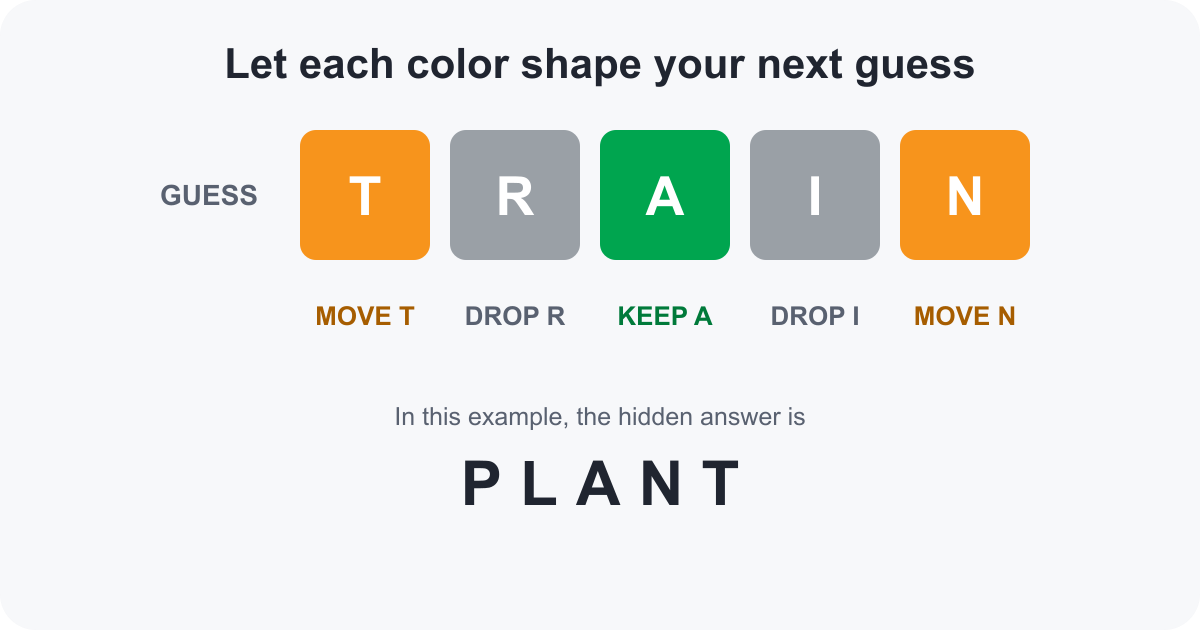
The feedback would be:
T is orange: T is in the answer, but it is not first.
R is gray: R is not in the answer.
A is green: A belongs in the third position.
I is gray: I is not in the answer.
N is orange: N is in the answer, but not in the fifth position.
You can summarize the evidence as:
Pattern: _ _ A _ _
Must include: T and N
T cannot be in position 1
N cannot be in position 5
Do not use: R or I
A useful second guess is:
CHANT
It follows all the evidence:
A remains third.
N moves away from the fifth position.
T moves away from the first position.
R and I are not reused.
C and H test two new letters.
Against PLANT, CHANT would produce:
C gray;
H gray;
A green;
N green;
T green.
You now know:
_ _ A N TYou can also eliminate C, H, R, and I.
PLANT fits every clue:
A is third;
N is fourth;
T is fifth;
none of the eliminated letters return.
The puzzle is solved through a chain of evidence:
TRAIN → CHANT → PLANT
The important point is not that PLANT suddenly looked promising. It is that every other choice was gradually restricted by the feedback.
Repeated letters: the important exception
Wordrow evaluates letter occurrences, not merely whether a letter appears somewhere in the answer.
Suppose the hidden answer is:
APPLE
and you guess:
ALLEY
The feedback would include:
A green;
the first L orange;
the second L gray;
E orange;
Y gray.
The orange L proves that the answer contains an L. The gray L does not contradict it. It tells you that the answer does not contain a second L.
In other words:
one colored L means at least one L is present;
an additional gray L means the extra copy is not needed.
Similarly, if both copies of a repeated letter receive green or orange feedback, the answer contains at least two copies.
When a repeated letter produces mixed colors, interpret the tiles together. Do not treat the gray tile as proof that the letter is completely absent.
Reading the on-screen keyboard
The keyboard colors summarize the strongest result received for each letter:
green outranks orange;
orange outranks gray.
This is useful for remembering which letters have been tested, but the keyboard does not show exact positions or quantities.
Always return to the completed rows when you need to know:
where an orange letter has already failed;
where a green letter is fixed;
whether a gray duplicate was merely an extra occurrence.
The rows contain the complete evidence. The keyboard is only a summary.
Recognizing useful word patterns
As positions become fixed, look for familiar structures:
common beginnings such as CH-, SH-, ST-, or TR-;
common endings such as -ER, -ED, -LY, or -NT;
common vowel and consonant arrangements;
repeated-letter possibilities;
word families that fit the known pattern.
For example:
_ I G H T
could produce several possibilities, including:
LIGHT;
MIGHT;
NIGHT;
RIGHT;
SIGHT;
TIGHT.
Do not spend rows guessing every member of the family one at a time. Look for a way to test several uncertain first letters efficiently.
Patterns suggest possibilities, but every proposed answer must still agree with all previous color feedback.
A simple solving rhythm
After every guess:
Fix the green letters.
Record the orange letters and their failed positions.
Eliminate gray letters, allowing for duplicate-letter exceptions.
Write the remaining pattern.
Choose a word that obeys the evidence.
Use unconfirmed positions to test useful new letters.
Check the word against every previous row.
Submit and repeat.
Common beginner mistakes
Treating each row as an unrelated guess.
Moving a green letter out of its confirmed position.
Returning an orange letter to the same position that already failed.
Forgetting to include an orange letter in the next possible answer.
Reusing a gray letter without a repeated-letter reason.
Assuming a gray duplicate means the letter is completely absent.
Guessing a familiar-looking word that contradicts earlier feedback.
Using repeated letters too early and testing fewer distinct letters.
Trying every member of a word family individually.
Focusing on speed instead of extracting information.
Looking only at the keyboard and forgetting the positional evidence in the rows.
If you get stuck
Stop guessing complete words for a moment and organize the evidence.
Write down:
the five-position pattern;
fixed green letters;
required orange letters;
positions where each orange letter cannot go;
eliminated letters;
possible repeated letters.
Then ask:
Are there common beginnings or endings that fit?
Have I tested enough vowels?
Could the answer contain a repeated letter?
Am I overlooking an earlier orange letter?
Are several possible answers separated by only one letter?
Could one probe word test several uncertain letters?
If necessary, use a row to gather information rather than forcing a weak answer guess. A purposeful test is more valuable than a random possibility.
Playing on Hare Publishing
Use the on-screen keyboard to enter letters. You can also select the puzzle and type using a physical keyboard.
Use the backspace key to remove letters from the current row before submitting it. Once five letters have been entered, select Enter to submit the guess and receive feedback.
The completed row and on-screen keyboard update automatically:
green indicates the correct letter in the correct position;
orange indicates a required letter in the wrong position;
gray indicates an unavailable letter occurrence.
A correct guess ends the puzzle successfully. If the sixth submitted guess is incorrect, the puzzle ends and displays the hidden answer.
Treat every colour as evidence, make every new guess answer a question, and let all six rows work together.