
How to Solve a Word Flower Puzzle: A Beginner’s Guide
In 10 seconds: Build words using the seven letters in the flower. Every word must include the center letter, but letters may be used more than once.
What kind of puzzle is this?
Word Flower is an open-ended word-building puzzle. Unlike a crossword, it does not give you a separate clue for each answer. Instead, you explore one small group of letters and try to discover as many accepted words as possible.
The flower contains:
one required center letter;
six outer letters.
Every answer must contain the center letter. The outer letters are available but optional: a word may use some or all of them.
There is no required solving order. You can begin with any word you notice and use it to lead you toward other words.
The rules
In Hare Publishing Word Flower:
Every word must contain the center letter.
Use only the seven letters shown in the flower.
Letters may be reused as many times as the word requires.
Words must contain at least four letters.
Each accepted word can be submitted only once.
A word must follow the letter rules and be included in the puzzle’s curated accepted-word list.
You do not have to use every outer letter in every word. A word that uses all seven flower letters at least once is called a pangram.
Meeting the letter rules makes a word eligible, but the puzzle’s curated list determines whether it is accepted. The list is designed to provide a consistent and playable collection of words rather than include every regional, specialist, or uncommon dictionary form.
The most important beginner idea
The letters are reusable ingredients, not letter tiles that get used up.
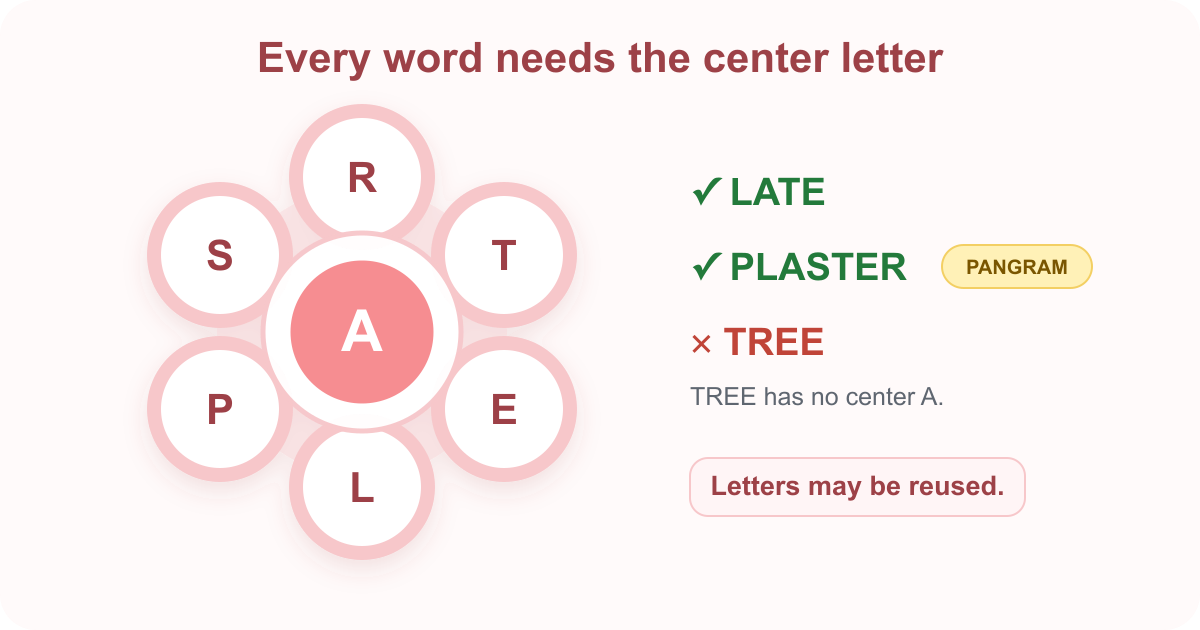
If the flower shows only one E, you may still make a word containing two or more Es. The same is true of the center letter and every outer letter.
For example, with center A and outer letters R, T, E, L, P, S:
LATE uses four of the available letters.
PLASTER uses all seven letters.
A word such as APPAREL may repeat A and P because repetition is allowed.
TREE cannot be used because it omits the required center A.
The center letter may appear at the beginning, middle, or end of a word. It may also appear more than once.
A reliable word-finding method
1. Make the center letter your anchor
Begin by focusing on the center letter. Combine it mentally with each outer letter and look for familiar beginnings, endings, or letter groups.
If A is in the center, you might explore combinations such as:
AR-
AL-
AP-
-AT
-ATE
-AR
These fragments may not be complete words, but they help your mind begin assembling possibilities.
2. Find ordinary four- and five-letter words
Do not begin by searching only for the longest or most unusual answer. Short, familiar words help you learn how the letters work together.
With center A and outer letters R, T, E, L, P, and S, you might begin with words such as:
LATE
RATE
PEAR
PALE
Each word must still contain A and use no letter outside the flower.
3. Grow word families
Whenever you find a word, treat it as a starting point rather than a finished discovery.
Ask:
Can it become plural?
Can I add an ending such as -S, -ER, -ED, -ING, or -LY?
Can I add a prefix?
Can I rearrange part of it to create a related word?
Is there a longer word containing the same base?
Only try an addition when all its letters are available in the flower.
For example, after finding RATE, you might test RATES or RATER. After finding LATE, you might test LATER or LATEST.
Not every possible form will necessarily appear in the accepted list, but word families are one of the most productive ways to generate ideas.
4. Deliberately try repeated letters
Many beginners unconsciously use each displayed letter only once. Break that habit intentionally.
Ask:
Could this word contain a double letter?
Could the center letter appear twice?
Could repeating a vowel create another word?
Could a familiar ending require a letter already used earlier?
A seven-letter flower can produce words much longer than seven letters because its letters may repeat.
5. Change your starting letter
If you keep seeing the same few words, make a deliberate sweep through the outer letters.
Try beginning a word with each letter in turn while keeping the center letter somewhere in the word:
words beginning with R;
then T;
then E;
and so on.
This prevents your mind from repeatedly following the same familiar path.
6. Move the center letter around
Do not assume the center letter must begin the word.
Try imagining it:
at the beginning;
after the first letter;
in the middle;
near the end;
in more than one position.
Changing the center letter’s position can reveal words that were hidden by your first mental pattern.
7. Search for a pangram
A pangram uses every one of the seven flower letters at least once. It may also repeat some of them.
With center A and outer letters R, T, E, L, P, and S, PLASTER is a pangram because it contains:
P, L, A, S, T, E, and R
Pangrams earn bonus points, but do not let the search for one prevent you from collecting ordinary words. Shorter words build progress and often help you notice the pangram later.
Worked example
For this example, assume that LATE, APPAREL, and PLASTER are included in the puzzle’s accepted-word list.
Suppose the flower contains:
center letter: A
outer letters: R, T, E, L, P, S
Consider four possible submissions.
LATE
It contains four letters.
Every letter appears in the flower.
It contains the center letter A.
LATE follows the Word Flower rules.
APPAREL
It contains only A, P, R, E, and L.
It contains the center letter A.
It repeats A and P, which is allowed.
APPAREL shows why the displayed letters are not single-use tiles.
PLASTER
It contains the center letter A.
It uses only flower letters.
It uses every one of the seven letters at least once.
PLASTER is a pangram.
TREE
It uses only letters shown in the flower.
However, it does not contain A.
TREE is invalid because every word must include the center letter.
The center letter is mandatory. The outer letters are optional, and every letter may be reused.
How scoring and progress work
In Hare Publishing Word Flower:
a four-letter word earns 1 point;
a word of five or more letters earns 1 point for each letter;
a pangram earns an additional 7-point bonus.
For example:
LATE earns 1 point.
PLASTER has seven letters and is a pangram, so it earns 7 points plus the 7-point pangram bonus, for 14 points.
Your completion percentage is based on the points you have found out of all possible points in the puzzle. This means longer words and pangrams move the progress bar more quickly than four-letter words.
You reach Master Gardener at 85% of the available points. You may continue searching after that. Puzzle Complete means you have found every accepted word.
You do not need to find every word to make worthwhile progress.
When a real word is not accepted
Before submitting a word, check four things:
Does it contain at least four letters?
Does it include the center letter?
Does it use only letters from the flower?
Have you already submitted it?
If the word passes those checks but is rejected, it is not included in that puzzle’s accepted-word list.
Any curated word list requires editorial boundaries. A familiar word may occasionally be absent, while an unfamiliar word may be included. Treat a rejection as information about the puzzle’s dictionary, not as a judgment about your vocabulary.
Move on and keep exploring the letters.
Common beginner mistakes
Forgetting to include the center letter.
Using a letter that does not appear in the flower.
Assuming each displayed letter may be used only once.
Believing every answer must use all seven letters.
Searching only for a pangram and overlooking ordinary words.
Finding a base word but not testing its other forms.
Looking only for words that begin with the center letter.
Repeating the same mental scan instead of changing the starting letter or letter pattern.
Becoming discouraged when a legitimate word is outside the accepted list.
If you get stuck
Use this reset routine:
Return to the shortest words and look for new four-letter combinations.
Review every word you found and test related forms.
Try placing the center letter in a different position.
Search deliberately for doubled letters.
Begin with each outer letter in turn.
Look for common beginnings and endings that can be made from the available letters.
Say or mentally rearrange the letters in a different order.
A pause does not mean there are no words left. It often means your mind has settled into one repeated letter pattern and needs a different entry point.
Playing on Hare Publishing
Select the flower letters—or type them on your keyboard—to build a word, then choose Enter to submit it.
Delete removes the most recent letter from the word you are building. Clear removes the entire current word. Accepted words appear in the Found Words list with their point values, and pangrams are identified.
Reveal Word supplies one remaining accepted word without ending the puzzle. Reveal All ends the puzzle and displays every remaining answer. Start Over clears your progress and restarts the puzzle.
Begin with familiar short words, grow them into families, and remember that the center letter belongs in every answer.
Find a word, extend it, rearrange it, and keep the center letter at the heart of your search.