
How to Solve a Word Search Puzzle: A Beginner’s Guide
In 10 seconds: Find every word from the list hidden in the letter grid. Words appear in straight lines horizontally, vertically, or diagonally, and they may run forward or backward.
What kind of puzzle is this?
A Word Search hides words inside a grid of letters. The unused spaces are filled with extra letters, making the words harder to see.
The word list tells you exactly what to find. Your task is to locate each word’s complete spelling in the grid.
The words are usually connected by a theme, such as retro diners, winter birds, or garden statues. The theme helps you understand the vocabulary, but the exact spelling of the words in the word list is what you must find.
The rules
Every hidden word appears in one straight, unbroken line.
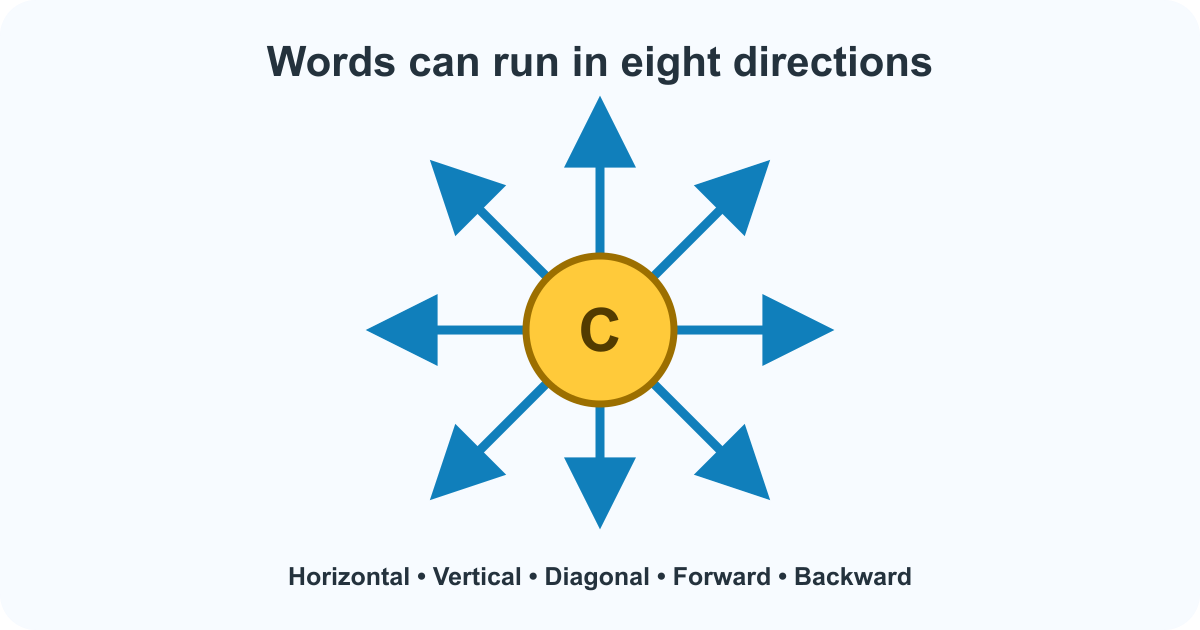
A word may run horizontally, vertically, or diagonally.
It may run in any of eight directions.
Words may appear forward or backward.
Every letter in the word must be in the correct order.
Consecutive letters must occupy neighboring squares with no gaps.
A word cannot turn a corner or change direction.
Hidden words may cross or share letters.
Multi-word entries appear as one continuous sequence without spaces.
The most important beginner idea
Do not search for the whole word everywhere at once.
Instead:
Find an anchor letter → check the next letter → follow one straight line → verify the complete word.
Suppose you are looking for:
CHEERS
Begin by finding a C. From each C, look at the neighboring squares for H.
If an H appears beside the C, continue in that same direction:
C → H → E → E → R → S
If the letters stop matching, abandon that path and check another direction or another C.
This turns a large visual search into a series of small checks.
A reliable solving method
1. Choose one word from the list
Focus on one target rather than trying to notice every listed word at once.
Read its exact spelling before searching. Pay attention to:
repeated letters;
unusual letters;
distinctive letter pairs;
the first and last letters;
the total length.
Long words are often useful starting points because their letter patterns are distinctive. Words containing uncommon letters such as J, Q, X, or Z may also be easier to locate.
The longest word is not automatically the easiest. What matters is how recognizable its spelling is in the grid.
2. Choose an anchor
The first letter is usually the simplest anchor.
For CHEERS, begin by scanning for C.
You can also use:
the last letter and search backward;
an unusual letter;
a doubled pair such as EE;
a distinctive group such as TH, CH, or QU.
If you use a letter from the middle of a word, remember that you must verify the letters on both sides of it. Beginners will usually find the first or last letter easier.
3. Scan systematically for the anchor
Move through the grid in an orderly pattern:
Scan the first row from left to right.
Move to the next row.
Continue until you reach the bottom.
Look only for your chosen anchor letter during this pass.
A systematic scan may feel slower than letting your eyes wander, but it prevents you from repeatedly searching the same areas while overlooking others.
4. Check the neighboring letters
When you find the anchor, look at the squares immediately around it.
A square can have as many as eight neighbors:
left and right;
above and below;
the four diagonals.
If you are searching from the first letter, look for the word’s second letter in those neighboring squares.
For CHEERS, look for an H beside each C.
If there is no H, that C cannot begin the word. Move to the next C.
5. Lock onto one direction
When the first two letters match, continue in exactly the same direction.
If C is followed by H to the left, every remaining letter must also continue to the left:
C ← H ← E ← E ← R ← S
The word cannot bend, skip a square, or change direction partway through.
6. Verify every letter
Do not mark a word after recognizing only its beginning.
Extra letters in the grid can create convincing false starts. Trace the complete spelling from beginning to end before selecting it.
Check:
Is every letter correct?
Are the letters next to one another?
Does the path remain straight?
Did you reach the complete final letter?
7. Mark the word and update the list
Once the full word is confirmed, highlight it. For Hare Publishing puzzles, this is done by select its two endpoints.
Then return to the word list and choose another target. Removing found words from your attention reduces the amount of information you must manage.
Understanding backward words
A backward word still contains the same spelling. It is simply placed in the opposite direction.
Suppose this row appears in the grid:
S R E E H C
Reading from left to right gives:
SREEHC
But begin at the C on the right and read toward the left:
C ← H ← E ← E ← R ← S
That spells CHEERS.
You can find backward words in either of two ways:
search for the word’s first letter and follow it in a backward direction; or
search for the word’s last letter and trace toward the first.
You do not need to reverse the spelling in your head if that feels confusing. Begin at the first letter of the listed word and follow the letters in whichever direction they appear.
Worked example
Suppose the target word is:
CHEERS
and part of the grid looks like this:
A T M P O L
N C A R D E
S R E E H C
B O T L I N
G U E S T R
K A Y P O D
Step 1: Identify the spelling
C H E E R S
The word has six letters and contains a repeated E.
Step 2: Find an anchor
Scan the grid for C.
There is a C in the second row and another at the right end of the third row.
Step 3: Check for H
The C in the second row does not have an H beside it, so it cannot begin CHEERS.
The C at the right end of the third row has an H immediately to its left.
Step 4: Continue in the same direction
Reading left from that C gives:
C → H → E → E → R → S
Every letter matches, the letters are adjacent, and the path remains straight.
Therefore, CHEERS runs horizontally from right to left.
The important point is that the C alone did not prove anything. The complete, uninterrupted sequence of letters confirmed the word.
How to find diagonal words
Diagonal words can be harder because your eyes naturally follow rows and columns.
Use the same anchor method:
Find the first letter.
Check the four diagonal neighbors for the second letter.
If the second letter matches, continue along that exact diagonal.
Verify the word through its final letter.
You may find it helpful to trace the path with your finger or cursor. This makes it easier to avoid drifting into a neighboring diagonal.
Remember that diagonal words can run:
down and right;
down and left;
up and right;
up and left.
How to find short words
Short words can be surprisingly difficult because their letters may appear together many times by chance.
For a short word:
Learn the entire spelling.
Scan for the first letter.
Check specifically for the second letter beside it.
Verify the final letter or letters immediately.
Do not rely on the word’s overall shape. With only three or four letters, systematic checking is more reliable than visual recognition.
Choosing which word to search for next
Useful starting choices include:
a long word with a distinctive spelling;
a word containing an unusual letter;
a word with a repeated letter;
a word with an uncommon beginning or ending.
A short word made from common letters may be better left until later.
Finding longer words first can also clear mental space and help you notice the shorter remaining entries.
Common beginner mistakes
Looking only from left to right.
Checking downward but forgetting that words can run upward.
Ignoring the four diagonal directions.
Allowing a word to bend or change direction.
Skipping a square between two letters.
Marking a word after recognizing only its first few letters.
Searching for several different words at the same time.
Assuming words cannot overlap.
Repeatedly scanning the same part of the grid.
Searching from an internal letter without verifying both sides of the word.
If you get stuck
Use this reset:
Choose one remaining word.
Read and count its letters carefully.
Select a different anchor—perhaps its last letter or an unusual internal letter.
Scan the grid row by row for that anchor.
At each occurrence, check all eight directions.
If you have concentrated on horizontal words, deliberately check vertical and diagonal paths.
Move to another word and return later if necessary.
Fresh attention often helps. After searching for the same word for too long, your eyes can begin skipping over the very pattern you need.
Playing on Hare Publishing
Select the first letter of a hidden word, then select its last letter. When the complete path matches a listed word, the word is marked as found, and its path is highlighted in the grid.
If your two selected letters do not form a correct hidden word, it will not be added to your found words. Recheck the spelling, endpoints, and direction.
For additional help, open Assist and choose one or both options:
Word Direction tells you which of the eight directions the selected word follows.
Show First Letter highlights every occurrence of that word’s first letter in the grid. It does not identify which occurrence is the correct starting point.
After choosing an Assist option, select an unsolved word from the Word List.
Start Over clears all your progress and restarts the puzzle. Reveal Answers ends the puzzle and displays every hidden word.
Choose one word, find its anchor, follow one straight line, and verify every letter before selecting it.