
How to Solve a Kriss Kross Puzzle: A Beginner’s Guide
PUZZLE ACADEMY · BEGINNER GUIDE
In 10 seconds: Fit every word from the list into the blank grid. Word lengths narrow the possibilities, and crossing letters reveal where each word belongs.
What kind of puzzle is this?
Kriss Kross is a word-placement puzzle. It looks like a crossword, but there are no clues to answer because all the words are already provided. The words usually share a theme, but the theme does not determine where they belong. Their positions are established by their length and the letters they cross.
Your task is to decide where each word fits in the grid.
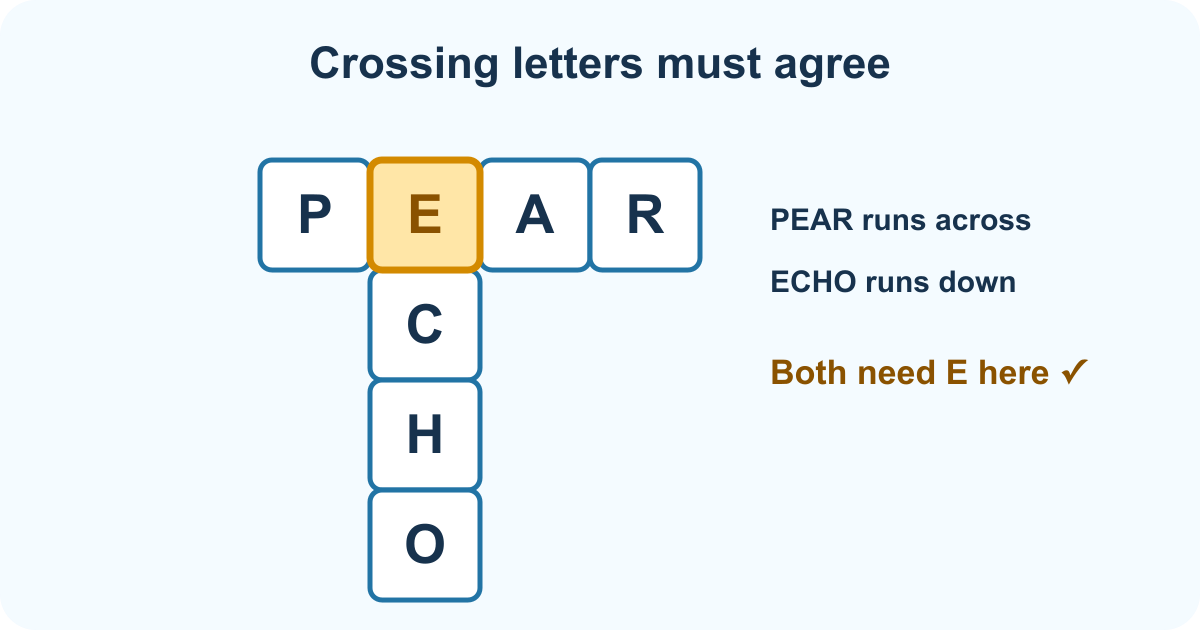
Each uninterrupted run of white squares is called a slot. A slot runs either across (left to right) or down. Where two slots cross, both words must use the same letter in the shared square.
You are not trying to invent words. You are using length and crossing letters to match every listed word to its one correct position.
The rules
Each slot contains one word.
A word must have exactly the same number of letters as its slot has squares.
Words run across (left to right) or down, never diagonally.
Words that cross must use the same letter in their shared square.
Every word in the list is used once.
The puzzle is complete when every word is in its correct slot.
The most important beginner idea
A word matching the length of a slot means it could fit there. It does not necessarily mean it belongs there.
Suppose an empty slot has four squares and six four-letter words remain. Length alone does not give you enough information to choose among them.
Now suppose the same slot contains the pattern:
_ E _ _
Any word placed there must be four letters long and have E as its second letter. The crossing letter has made the choice much more specific.
The central question is therefore not simply:
“Can this word fit?”
It is:
“What evidence makes this the correct word?”
A reliable solving method
1. Survey the grid and the word list
Begin by noticing the different slot lengths. Then look at how many words are available for each length.
If the grid contains only one 11-square slot and the list contains only one 11-letter word, that placement is certain.
Long words are often helpful because fewer words share their length, but the longest word is not automatically the correct starting point. What matters is how many possible matches remain.
2. Find the most constrained slot
A constrained slot is one with relatively few possible words.
Good starting points include:
a length represented by exactly one remaining word and one empty slot;
a slot that already contains one or more crossing letters;
a length shared by only a few remaining words;
a pattern that only one remaining word can match.
Avoid beginning with a completely empty short slot when many words of that length remain.
3. Compare the entire pattern
Check every known letter, not just one.
For example, a six-square slot showing:
_ A _ _ E _
needs a six-letter word with A in the second position and E in the fifth. A candidate that matches the A but not the E cannot belong there.
4. Use every new crossing letter
When you place a well-supported word, look immediately at every slot it crosses.
The newly supplied letters may turn patterns such as:
_ _ _ _
into:
_ R _ _
or:
_ R _ E
Each additional letter reduces the number of possible words.
5. Work outward from confirmed placements
Kriss Kross is usually solved as a chain reaction:
Confirm one word → gain crossing letters → confirm another word → gain more letters.
Build outward from words you know rather than filling isolated parts of the grid at random.
6. Recheck the remaining words
As words are placed, the list becomes smaller. A choice that was uncertain earlier may become obvious once competing words have been used elsewhere.
Return regularly to unresolved slots and compare them with the remaining words.
Worked example
Suppose ECHO has already been placed downward. Its first letter, E, appears in the second square of a four-letter slot running across:
_ E _ _
The remaining four-letter words are:
PEAR
LION
MINT
Compare each word with the pattern:
PEAR has E in the second position.
LION does not.
MINT does not.
Therefore, PEAR belongs in the across slot.
PEAR and ECHO agree at their shared E. Placing PEAR also adds P, A, and R to other crossing slots, giving you new information for your next choices.
The important point is not that PEAR has the correct length. All three candidates do. PEAR is correct because it matches both the length and the crossing letter.
What if two words still fit?
Do not force a decision. Leave that slot unresolved and work somewhere else.
A later crossing letter may separate the two possibilities without any guessing.
If you eventually need to test a possibility:
Place one candidate temporarily.
Follow the letters it creates into the crossing slots.
Check whether the remaining words can still fit.
If a crossing becomes impossible, remove the tested word and try the other candidate.
Keep the test small. Do not build a large section of the grid on top of an unsupported choice.
Common beginner mistakes
Assuming that a word belongs in a slot simply because its length matches.
Starting with short, empty slots that have many possible words.
Ignoring one crossing letter because the rest of a word looks promising.
Treating a tentative placement as though it were confirmed.
Forgetting that every listed word can be used only once.
Continuing to build from a doubtful word after other slots stop working.
Trying to solve the grid in reading order instead of moving to the most informative slot.
If you get stuck
Return to the remaining word list and group the words by length.
Then look for:
a length with very few words remaining;
a slot containing the most crossing letters;
a letter pattern matched by only one remaining word;
an area connected to several other unfinished slots.
If no remaining word fits a slot, one of the words already placed nearby is probably wrong. Revisit the most recent uncertain placement rather than clearing words that were strongly supported.
Playing on Hare Publishing
Select a slot in the grid, then select a word from the list to place it. If a square belongs to both an across and a down slot, select it again to switch direction.
Hint: ON highlights unused words with the same length as the selected slot. It narrows the choices by length but does not identify the correct word.
A correctly placed word receives a checkmark. A word that has been placed without a checkmark should still be treated as provisional. The puzzle will also prevent you from placing a word that conflicts with crossing letters already in the grid.
Clear removes the word from the selected slot. Start Over clears the entire puzzle. Reveal Answers ends the puzzle and displays the completed grid.
Begin with the strongest evidence, use every crossing letter, and let each confirmed word reveal the next.