
How to Solve a Sudoku Puzzle: A Beginner’s Guide
PUZZLE ACADEMY · BEGINNER GUIDE
In 10 seconds: Fill the grid with the numbers 1–9 so that every row, every column, and every 3×3 box contains each number exactly once.
What kind of puzzle is this?
Sudoku is a logic puzzle, not a mathematics test. You will not need to add, subtract, or perform any calculations.
The numbers simply act as nine different symbols. They could be replaced with letters or shapes, and the puzzle would work in exactly the same way.
A standard Sudoku has 81 spaces called cells, arranged in:
nine horizontal rows;
nine vertical columns;
nine outlined 3×3 boxes.
Some cells already contain numbers. These starting numbers are called givens, and they cannot be changed. Your task is to use them to determine the value of every empty cell.
The rules
Fill every empty cell so that:
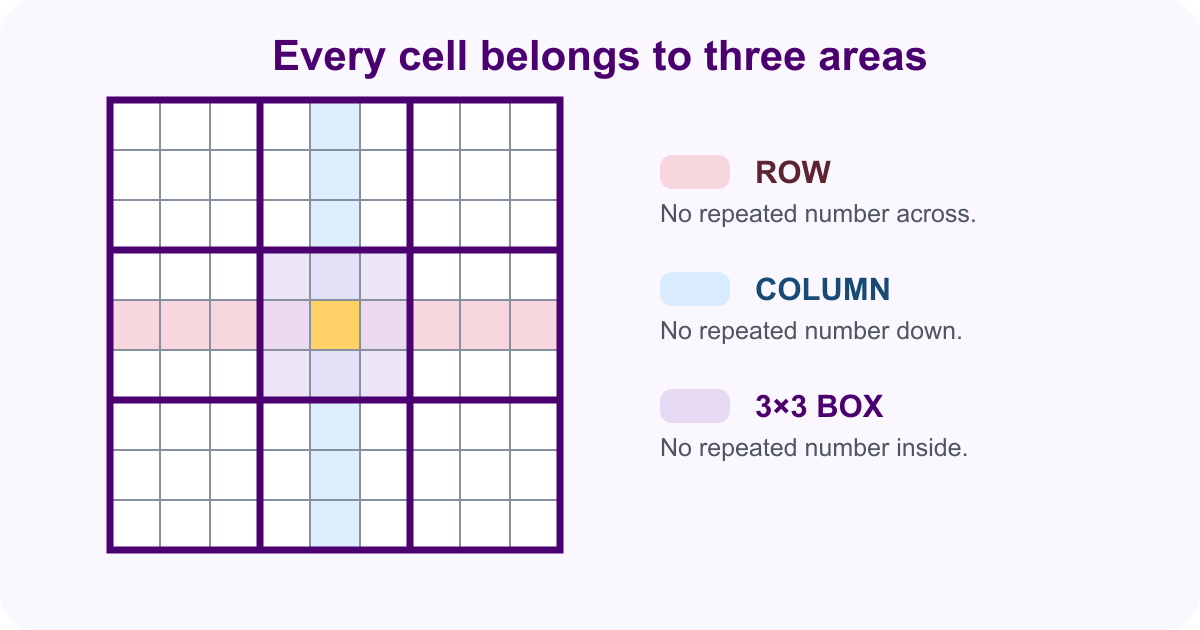
each row contains the numbers 1–9 exactly once;
each column contains the numbers 1–9 exactly once;
each 3×3 box contains the numbers 1–9 exactly once.
No number may repeat within any row, column, or box.
Every cell belongs to all three kinds of area at the same time: a row, a column, and a box. A number can be placed in a cell only when it is allowed in all three.
The most important beginner idea
Sudoku is solved by elimination.
You are not asking which number looks likely. You are ruling out numbers that cannot go in a particular place until only one possibility remains.
There are two useful questions to alternate between:
What number can go in this cell?
Look at the cell’s row, column, and box. Eliminate every number that already appears in any of those three areas (row, column, and 3×3 box).
If only one number remains possible, that number belongs in the cell.
Where can this number go in this area?
Choose a missing number and examine every empty cell in a row, column, or box.
If the number is blocked from all but one cell, that remaining cell is its only possible location.
Beginners often ask only the first question. Learning to ask both is one of the biggest steps toward solving Sudoku confidently.
A reliable solving method
1. Begin with the Easy puzzle
All three difficulty levels use exactly the same rules. Easy puzzles simply provide more immediate starting points and shorter chains of reasoning.
Use the Easy level while you become comfortable checking rows, columns, and boxes. Move to Medium and Hard when the basic scanning process feels familiar.
2. Scan the fullest areas
Look for a row, column, or box containing many givens.
If a row has eight numbers and one empty cell, identify the only number missing from 1–9. That number must fill the empty cell.
For example:
5 3 4 6 7 8 9 1 _
The only missing number is 2, so the final cell must contain 2.
3. Find cells with only one possible number
When an area is missing several numbers, check each empty cell against its row, column, and box.
Suppose a particular cell’s row is missing:
2, 7, and 9
The cell’s column already contains 2 and 9. Those possibilities are eliminated, leaving only 7.
If 7 is also allowed in the cell’s box, the cell must be 7.
A cell with only one remaining possibility is commonly called a naked single. The name is less important than the reasoning: every other number has been ruled out.
4. Look for the only place a number can go
Sometimes an empty cell can hold several possible numbers, but a particular number has only one possible location within an area.
Suppose a 3×3 box is missing 2, 6, and 7. After checking the rows and columns passing through its empty cells, you discover that only one cell can contain 7.
Place 7 in that cell.
This is often called a hidden single. The cell may have appeared to have several possibilities, but 7 has no other possible home in that box.
5. Scan one number across the whole grid
Choose a number—such as 6—and locate every 6 already in the puzzle.
Now examine each 3×3 box that does not yet contain a 6. Existing 6s in the crossing rows and columns rule out certain cells. If only one position remains available in a box, place the 6 there.
This technique is sometimes called crosshatching, but you do not need to remember the name. The important action is using existing numbers to block impossible positions.
6. Re-scan after every confirmed entry
Every number you place affects three areas:
its row;
its column;
its 3×3 box.
A new entry may complete one area, remove a possibility from another cell, or leave a number with only one possible location.
Sudoku is usually solved through a repeating cycle:
Place one certain number → update the affected areas → look for the next certainty.
Worked example
Consider an empty cell whose row is missing three numbers:
2, 7, and 9
Now check the cell’s column:
The column already contains 2, so the cell cannot be 2.
The column already contains 9, so the cell cannot be 9.
After checking the row and column, 7 is the only remaining candidate. The cell’s box must still be checked.
The box does not already contain 7, so 7 is allowed. Therefore, the cell must contain 7.
Therefore, the cell must contain 7.
The reasoning can be written as:
Row possibilities: 2, 7, 9 → column removes 2 and 9 → only 7 remains.
The answer is not based on a guess. It is forced because every other possibility has been eliminated.
When to use notes
A candidate is a number that could still fit in an empty cell.
If a cell could be either 2 or 7, record both as small notes rather than entering one as the final answer. Later, if 7 is placed elsewhere in the same row, column, or box, you can remove 7 from the notes and confidently enter 2.
Use notes when:
the immediate singles have been filled;
several cells still have two or three possibilities;
you need to compare where a particular number can appear.
A note records a possibility, not a decision.
Keep notes current. Whenever you place a number, remove that number from the notes in the same row, column, and box.
For a first Easy puzzle, you may not need notes immediately. Filling every empty cell with every possible candidate at the beginning can create more clutter than help.
A simple solving rhythm
Scan rows for missing numbers.
Scan columns.
Scan 3×3 boxes.
Look for cells with only one possible number.
Look for numbers with only one possible location in an area.
Update notes after every confirmed entry.
Repeat.
When one type of scan stops producing answers, switch to another. A number that is difficult to find by examining cells may become obvious when you scan that number across the entire grid.
Understanding the difficulty levels
Easy, Medium, and Hard use the same 9×9 grid format and the same fundamental rules. Each level is a different puzzle, and the difficulty describes how much deduction is usually required.
Easy puzzles offer more immediate singles and shorter solving chains.
Medium puzzles generally require more systematic scanning and candidate notes.
Hard puzzles may require you to combine several deductions before another number becomes certain.
A harder puzzle does not require faster thinking. It requires more careful tracking of what remains possible.
Common beginner mistakes
Checking the row but forgetting the column or box.
Entering a number because it looks plausible rather than because every alternative has been eliminated.
Treating a candidate note as a confirmed answer.
Looking only for cells with one candidate and overlooking numbers that have only one possible location within an area.
Assuming each 3×3 box is a separate mini-puzzle. Every box interacts with the rows and columns passing through it.
Failing to update notes after placing a number.
Staring at one difficult cell instead of gathering information elsewhere.
Thinking that getting stuck means you need to guess.
If you get stuck
Stop concentrating on the same cell and use a systematic reset:
Check the fullest rows, columns, and boxes again.
Choose one number and scan for it across all nine boxes.
Look for an area where one candidate appears in only one cell.
Update notes that may no longer be valid.
Recheck any entry that was not supported by a clear reason.
If an area appears to have no possible place for a required number, one of your earlier entries is probably incorrect. Revisit the most recent uncertain entry before changing numbers that were strongly supported.
Playing on Hare Publishing
Choose Easy, Medium, or Hard, then select an empty cell and choose a number.
Notes Mode lets you record small candidate numbers. Erase removes the entry from the selected cell, and Undo reverses your most recent action.
Hints: ON highlights information related to the selected cell, including matching numbers and conflicting entries. It supports your scanning but does not choose the next answer for you.
Check: ON displays correct entries in green and incorrect entries in red. Reveal Cell supplies the answer for one selected cell. Start Over clears the puzzle and resets the timer. Reveal Answers ends the puzzle and displays the completed grid.
Begin with the Easy level and focus on explaining each entry to yourself:
“This number must go here because every other possibility has been eliminated.”
Scan, eliminate, place one certain number, then scan again.