
How to Solve a Cryptogram: A Beginner’s Guide
In 10 seconds: A cryptogram is a short message, such as a quote, joke, or saying, written in a letter-substitution code. Each letter in the original text has been replaced by a different letter. Your job is to work out the code and reveal the original message.
What kind of puzzle is this?
A cryptogram is a pattern-and-language puzzle. You are not expected to know the message. You solve it by noticing word shapes, repeated letters, common short words, and the way one good letter choice affects the whole message.
The spaces and punctuation remain in place, so you can already see where each word begins and ends. Only the letters are disguised.
The rules
The same cipher letter always represents the same original letter everywhere it appears in that puzzle.
Two different cipher letters cannot represent the same original letter.
Spaces, punctuation, and apostrophes remain unchanged.
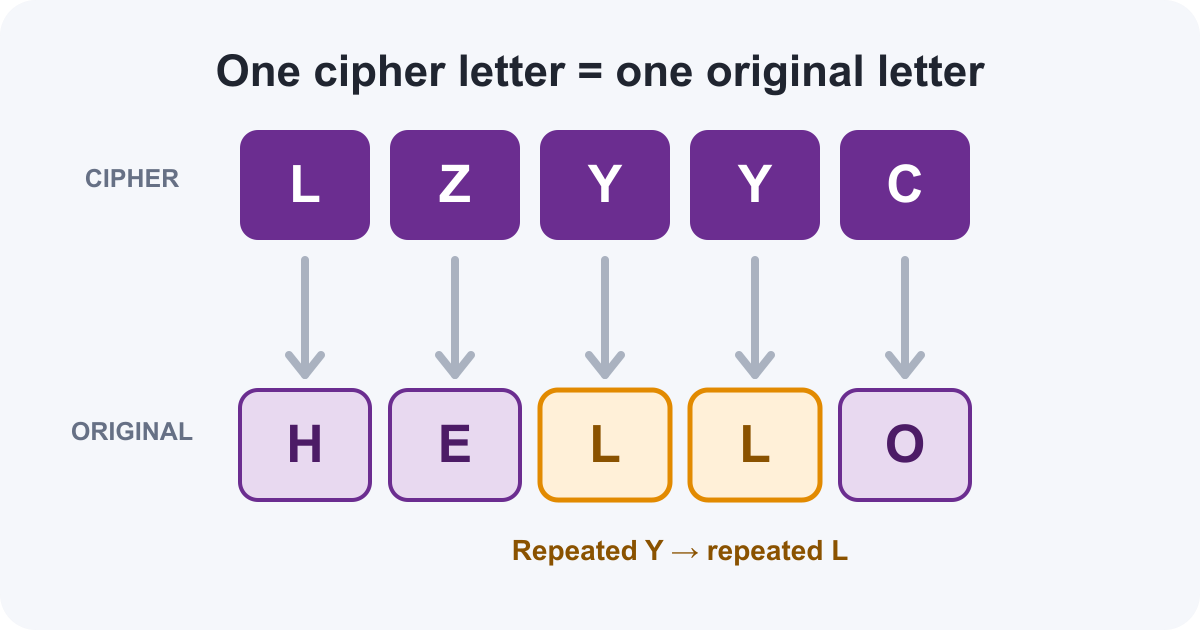
Letter patterns are preserved: repeated cipher letters become repeated original letters.
A guess must work everywhere that cipher letter appears—not just in one word.
A reliable way to begin
1. Look at word shapes before guessing letters
A word such as LZYYC has the pattern 1-2-3-3-4: five letters, with the third letter repeated. Any possible answer must have that same shape. HELLO fits; HOUSE does not.
Pay particular attention to:
one-letter words, which are usually A or I;
apostrophes reveal the shape of contractions and possessives. One letter after an apostrophe may suggest forms such as ’S, ’T, ’D, or ’M; two letters may suggest ’RE, ’VE, or ’LL.
repeated short words;
double letters;
common endings such as -ING, -ED, or -LY.
These are possibilities, not guarantees. Treat them as starting points to test.
2. Make one small, useful guess
Choose a guess that will reveal several letters or affect several words. Entering a frequently repeated cipher letter gives you more information than filling a letter that appears only once.
3. Read the message again
After every useful mapping, scan the whole message. Partial patterns such as T_E, _ING, or _O_’T may now suggest another word. Cryptograms are solved in a loop: guess, update, reread, and revise.
4. Check the guess against every appearance
If cipher Y means real L, then every Y must behave like L in that puzzle. If one part of the message becomes impossible, the mapping is probably wrong. Remove it and test another idea.
Worked example
Suppose the cipher phrase is:
LZYYC ACXYT
For this short demonstration, suppose you suspect that the cipher word LZYYC represents HELLO. The two words have the same repeated-letter pattern: 1-2-3-3-4.
Testing that possibility gives four mappings:
L → H
Z → E
Y → L
C → O
Because Y appears twice, entering Y → L fills both positions automatically. Those same mappings also update every L, Z, Y, and C elsewhere in the puzzle.
If the next cipher word is ACXYT, the existing mappings turn it into:
_ O _ L _
The pattern may suggest WORLD. Testing WORLD adds A → W, X → R, and T → D, producing HELLO WORLD.
This miniature example demonstrates the solving process: identify a possible word, apply its mappings everywhere, and use the new letter patterns to test the next word. In a full cryptogram, the surrounding words provide additional evidence before you confirm a guess.
Common beginner mistakes
Guessing from meaning alone while ignoring the word’s repeated-letter pattern.
Changing the same cipher letter in different places. All instances of a cipher letter in the puzzle must map to the same original letter.
Becoming attached to a promising word after it creates nonsense elsewhere.
Trying to solve from left to right. The most useful entry point may be in the middle.
Treating letter frequency as proof. Common cipher letters may represent E or T, but a short message can behave differently.
If you get stuck
Move away from the hardest word. Find a repeated short word, a double letter, or an apostrophe somewhere else. One confirmed mapping can unlock several areas at once.
Playing on Hare Publishing
Select a cipher letter, then choose the original letter you think it represents. Every occurrence of that cipher letter updates automatically across the puzzle, so you can immediately see how your choice affects the surrounding words. Check Progress tests your current mappings; Reveal Letter reveals the original letter for the selected cipher letter; Reveal Answer ends the puzzle and displays the complete original text.
Start with one strong pattern, then let each confirmed letter reveal the next step.