
How to Solve a Knights & Knaves Puzzle: A Beginner’s Guide
In 10 seconds: Every character is either a Knight, who always tells the truth, or a Knave, who always lies. Your job is to identify everyone by finding the only set of identities that makes all their statements behave correctly.
What kind of puzzle is this?
Knights & Knaves is a logic puzzle about truth and falsehood. You are not deciding who sounds honest. You are testing what must be true or false based on each speaker’s identity.
The puzzle works in both directions:
If you know someone is a Knight, you know their statement is true.
If you know someone is a Knave, you know their statement is false.
If an assumption makes a statement behave incorrectly, you know the assumption must be wrong.
That back-and-forth relationship is the key to solving the puzzle.
The rules
Every character is either a Knight or a Knave—never both and never neither.
A Knight’s complete statement is true.
A Knave’s complete statement is false.
A character may speak about themselves, another character, or several characters.
Some characters may not speak. You can still identify them from what others say.
Your final answer must make every statement work at the same time.
The most important beginner idea
A Knave does not necessarily say the exact opposite of every detail. Their whole statement must be false.
Suppose a Knave says:
“Matilda is a Knight and Amabel is a Knave.”
The combined statement is false, so at least one part must be wrong. Matilda might not be a Knight, Amabel might not be a Knave, or both parts might be wrong. You cannot automatically reverse both parts.
This distinction becomes especially important when a statement contains and, or, or if.
A reliable solving method
1. Read the statements before assigning anyone
Notice which characters are mentioned together. A short, direct statement or a claim that two people have the same or opposite identities often gives a useful starting point.
You do not have to begin with the first speaker. Begin with a statement whose consequences are easiest to follow.
2. Make one temporary assumption
Choose a speaker and suppose they are a Knight. Their statement must then be true. Write down what this would force you to believe about the other characters.
For example:
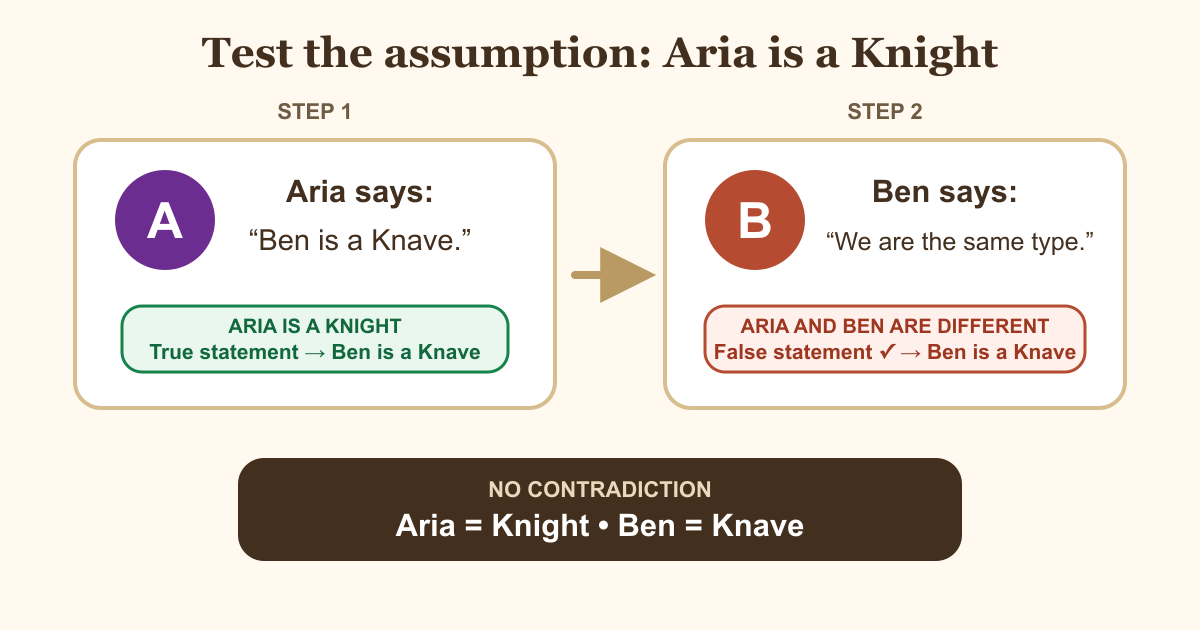
Suppose Aria is a Knight → Aria’s statement is true → Ben is a Knave.
An assumption is not a guess you are committing to. It is a possibility you are testing.
3. Follow the consequences
Carry each new identity into the other statements:
A character identified as a Knight must be making a true statement.
A character identified as a Knave must be making a false statement.
Continue until the identities fit together or something impossible happens.
4. Look for a contradiction
A contradiction is an impossible result under the puzzle’s rules—for example:
a Knight would have to be making a false statement;
a Knave would have to be making a true statement; or
the same character would have to be both a Knight and a Knave.
If your assumption creates a contradiction, the assumption is wrong. The starting speaker must be the opposite type.
5. Verify the complete solution
Do not stop when one or two statements work. Read every statement again using your proposed identities. Every Knight’s full statement must be true, and every Knave’s full statement must be false.
Worked example
Aria says:
“Ben is a Knave.”
Ben says:
“We are the same type.”
Test 1: Suppose Aria is a Knight
Aria’s statement must be true.
Therefore, Ben is a Knave.
Aria and Ben are different types, so Ben’s statement is false.
That is exactly how a Knave’s statement should behave.
This assumption produces no contradiction. It gives Aria: Knight and Ben: Knave.
Test 2: Suppose Aria is a Knave
Aria’s statement must be false.
“Ben is a Knave” is false, so Ben must be a Knight.
Aria and Ben are different types, so Ben’s “same type” statement is false.
But Ben is supposed to be a Knight, and a Knight cannot make a false statement.
This assumption creates a contradiction, so it cannot be the solution.
The only solution is Aria: Knight; Ben: Knave.
How to understand common statement words
Conjunction (AND): “A and B”
Both parts must be true for the complete statement to be true.
“Matilda is a Knight and Amabel is a Knave.”
This is true only if Matilda is a Knight and Amabel is a Knave. If either part is wrong, the complete statement is false.
Using this in a Knights & Knaves puzzle
If the speaker is a Knight, both parts must be true. Matilda must be a Knight, and Amabel must be a Knave.
If the speaker is a Knave, the combined statement must be false. At least one part must therefore be wrong, but you cannot yet conclude which one. Matilda might be a Knave, Amabel might be a Knight, or both.
Disjunction (OR): “A or B”
At least one part must be true. In these puzzles, both parts may also be true.
“Matilda is a Knight or Amabel is a Knave.”
This is true when Matilda is a Knight, or when Amabel is a Knave, or when Matilda is a Knight and Amabel is a Knave.
This is false only when Matilda is not a Knight and Amabel is not a Knave.
Using this in a Knights & Knaves puzzle
If the speaker is a Knight, at least one part must be true. Matilda may be a Knight, Amabel may be a Knave, or both claims may be true.
If the speaker is a Knave, the complete OR statement must be false. That is possible only when both parts are false. Matilda must therefore be a Knave, and Amabel must be a Knight.
Conditional statement: “If A, then B”
A conditional statement connects a condition to a required result:
If A is true, then B must also be true.
Think of it as a promise. The promise does not tell you whether A will happen. It tells you what must happen if A does.
The conditional is false in only one situation: A is true, but B is false. In every other situation, the promise has not been broken.
Consider:
“If Matilda is a Knight, then Amabel is a Knave.”
There are four possibilities:
Matilda is a Knight and Amabel is a Knave: True. The condition occurs, and the promised result follows.
Matilda is a Knight and Amabel is a Knight: False. The condition occurs, but the promised result does not follow.
Matilda is a Knave and Amabel is a Knave: True. The condition did not occur, so the promise was not broken.
Matilda is a Knave and Amabel is a Knight: True. Again, the condition did not occur, so the promise was not broken.
The key point is that when Matilda is a Knave, this statement does not determine Amabel’s identity. It only tells you what must be true if Matilda is a Knight.
Using this in a Knights & Knaves puzzle
If the speaker is a Knight, the conditional statement is true. If you already know that Matilda is a Knight, Amabel must therefore be a Knave. However, if Matilda is a Knave, the statement does not determine Amabel’s identity.
If the speaker is a Knave, the conditional statement must be false. A conditional is false only when its condition is true, and its promised result is false. Therefore, Matilda must be a Knight, and the claim that Amabel is a Knave must be false—so Amabel must also be a Knight.
Condition is true → Matilda is a Knight.
Result is false → Amabel is not a Knave.
Therefore → Amabel is a Knight.
Biconditional statement: “A if and only if B”
A biconditional statement says that two claims must have the same truth value:
A and B must either both be true or both be false.
You can think of it as a two-way connection: if A is true, B must be true—and if B is true, A must be true.
Consider:
“Matilda is a Knight if and only if Amabel is a Knave.”
There are four possibilities:
Matilda is a Knight and Amabel is a Knave: True. Both claims are true.
Matilda is a Knight and Amabel is a Knight: False. The first claim is true, but the second is false.
Matilda is a Knave and Amabel is a Knave: False. The first claim is false, but the second is true.
Matilda is a Knave and Amabel is a Knight: True. Both claims are false.
In this example, a true biconditional means Matilda and Amabel are opposite types.
Using this in a Knights & Knaves puzzle
If the speaker is a Knight, the biconditional must be true. Matilda and Amabel must therefore be opposite types: one is a Knight, and the other is a Knave.
If the speaker is a Knave, the biconditional must be false. One claim must be true and the other false. Matilda and Amabel must therefore be the same type: either both Knights or both Knaves.
Common beginner mistakes
Deciding someone is a Knight because their statement sounds believable.
Assuming every part of a Knave’s statement must be the opposite of what they said.
Forgetting that “or” means at least one part is true, and it may include both.
Treating “if A, then B” as though A and B must always have the same value.
Keeping an assumption after it creates a contradiction.
Checking one speaker but forgetting to verify the complete set.
Trying to hold every consequence in your head instead of writing a short chain.
If you get stuck
Write two possible starting lines:
If Aria is a Knight, then…
If Aria is a Knave, then…
Follow one line until it produces a contradiction or a completely consistent solution. If neither line resolves quickly, choose a different speaker whose statement gives more direct information.
For your first few puzzles, begin with the Easy level. Every level uses the same fundamental rules. Medium and Hard add more characters, more compound statements, and longer chains of consequences, but there is no new underlying rule to learn.
Playing on Hare Publishing
Read the statements, then choose Knight or Knave on every character card. Press Enter to test the complete set. Logic Notation shows a symbolic version of the statements, but it is optional—the puzzle can be solved entirely from the written language. Reveal Puzzle ends the current level and displays the solution.
Make one assumption, follow every consequence, and let contradictions eliminate what cannot be true.